Monday, January 7, 2013

Japanese traditional culture ~14~ nanakusa gayu

  On 7th January, Japanese people eat nanakusa gayu in the morning.
It is one of Japanese traditions. But I don't think a lot of people keep this tradition.
I don't keep that tradition.
Nanakusa means "7 kinds of grass"
Gayu is a variation of rice. You put in a lot of water when you cook rice.
It  is mushy rice.
 7 kinds of grass are below.
Seri  = Water dropwort
Nazuna = Shepherd's Purse
Gogyou = Cudweed
hakobera = shickweed
hotokenoza = Nipplewort
suzuna = Turnip
suzushiro = Radish
 I used to remember these grass. It is a nice question for a quiz.
 People eat this Nanakusa gayu for their health.
Nowadays, it is not easy to get these kind of stuff in nature.
I guess it was so easy in old days. Now you can buy the packed nanakusa gayu
at supermarket.

Facebook page

Sunday, January 6, 2013

Japanese traditional culture ~13~ jyuuni shi

I explain what "jyuuni shi" is.(十二支 じゅうにし)
In Japanese culture, each year has each animals called "jyuunishi.
Every year, the animal changes according to the order.
Jyuuni means twelve(12).
12 kinds of animals are here.
1 mouse
2 cow
3 tiger
4 rabbit
5 dragon
6 snake
7 horse
8 sheep
9 monkey
10 chicken
11 dog
12 the wild boar
For example, 2013 is the year of snake.
Last year was dragon. 2014 is the year of horse. After the year of the wild boar,
the next year begins from the mouse.
I got some nengajou(postcard) from my friends. Can you see the picture of snake?

This tradition came from China in the old days.
Sometimes we ask someone what kind of the year he or she was born.
I was born in 1978. It was the year of horse. So I answer "Uma doshi".
Uma means horse. Doshi means "the year"

Saturday, January 5, 2013

Japanese traditional culture ~12~ Hatsumoude

  I went to Hatsumoude on 2nd January.
Hatsumoude means like "visiting a shrine firstly"
This is traditional event. A lot of japanese people got to shrine or temple
to pray so that they would be able to live safely in the whole year.
Or they pray so that they would have good things in the year.
  I went to Tamamura hachimangu, where I have introduced on this blog before.
I saw a lot of people there. I heard this shrine has been religious important place.
There was a worshiper from Knagawa prefecture,(it is located in the south of Tokyo)
for long years ago.
  Anyway, I attach some photos here. Please feel the atmosphere of Hatsumoude.


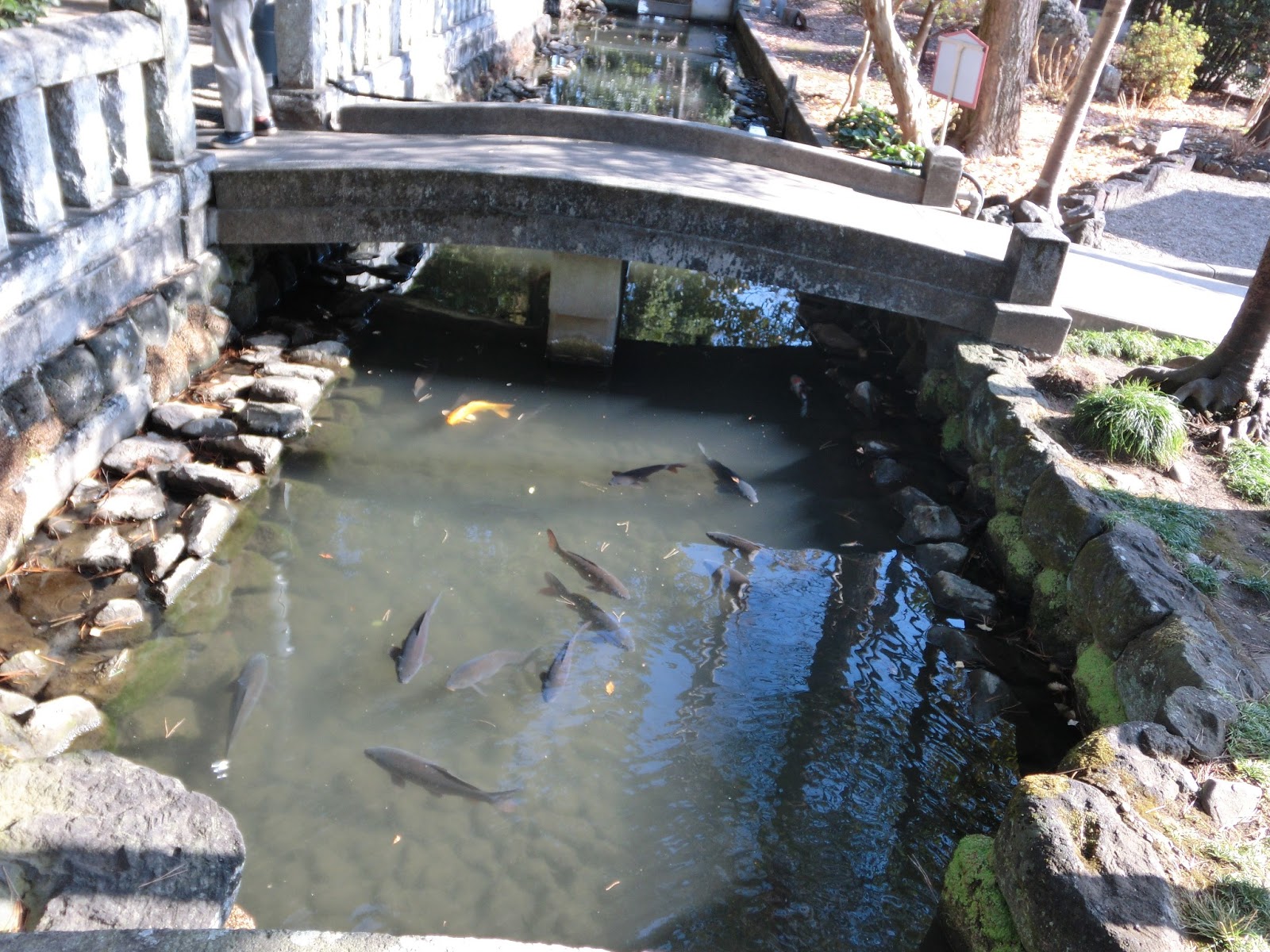
 I saw a lot of carps.


 You pray here.
You put in a coin. It should be 5 yen.
We pronounce 5 yen "ごえん(go en)" It means you have good luck to meet good person.
There is a way to pray.
1 put in a coin in a box
2 ring the bell
3 bow two times
4 crap two times
5 bow one time
This is my way. I guess all people do like this in Japan


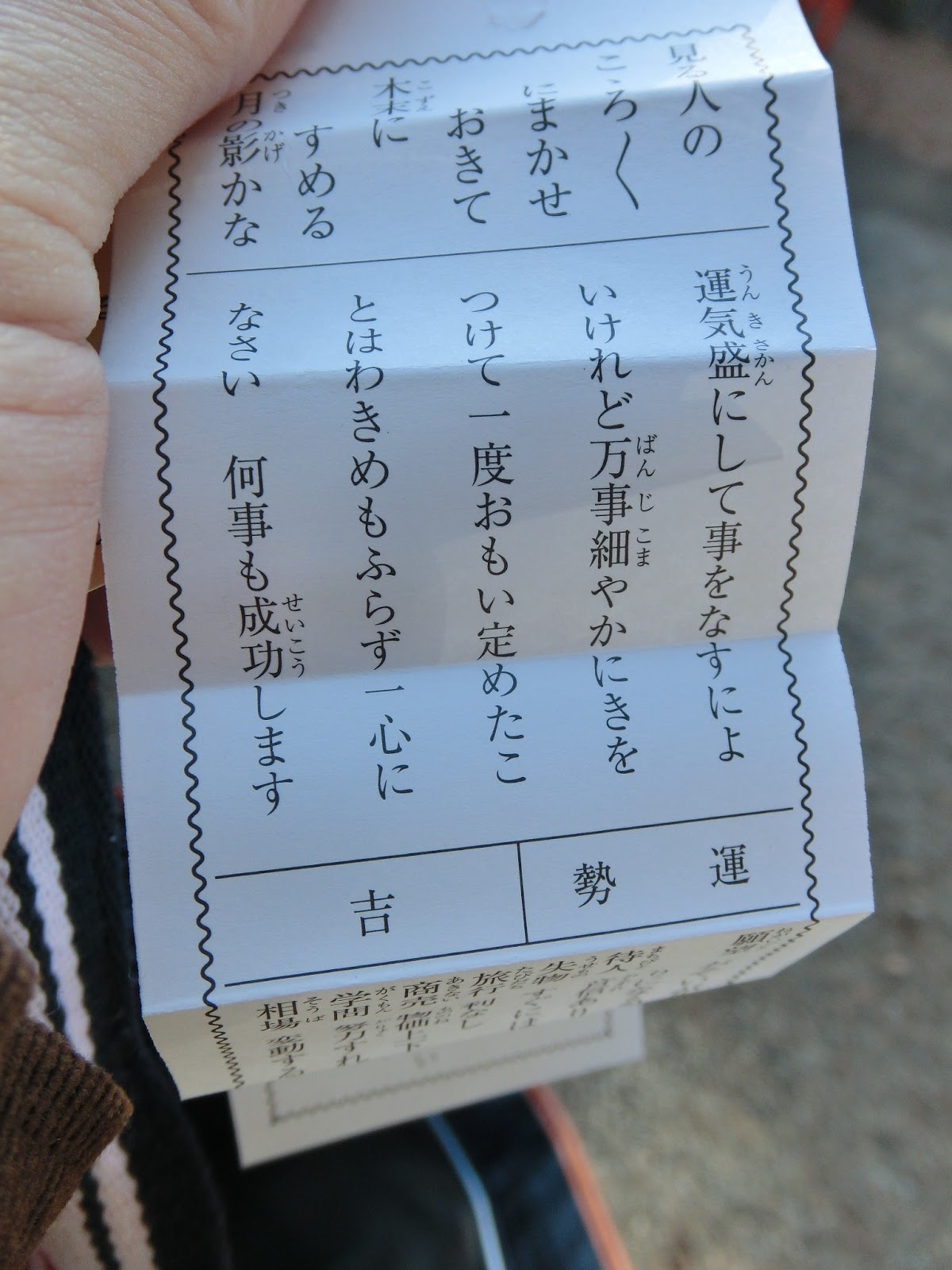
This is Omikuji.(おみくじ) You can see the luck.


The luck is 吉(kichi) It means"even".

I got this sea bream. Sea bream is good fish in Japan.

The hope : you would achieve it but it would be late.
The person you wait : he or she would come
The things you lost : you would not find it soon
The travel : no benefit you should not go
Business : even
study : it would be better if you make an effort
The stock quotation : the price would move. Make an action.
conflict : even if you are calm
love : watch out the rival in love
moving your house : not good
childbirth : an easy delivery
disease : don't worry
The marriage : it would go well if you don't change your mind


 Thanks for reading!
Facebook page

Friday, January 4, 2013

Japanese traditional culture ~11~ shimenawa

Some of Japanese people set the shimenawa near the door in this shougatsu season.


Shimenawa is one of the tool in Shintoism.
I heard that shimenawa has the meaning of protecting from evil or disasters.
It is set we should set the shimenawa until on 28ts December. You should not
set on 29th December. In Japanese, we pronounce 9 "ku". ku reminds people
苦(ku). 苦 means "pain, suffering".
And you should not set this shimenawa on 31st December. This is called
"Ichiya kazari".
"Ichiya kazari " means one night decolation. This is impolite to God. So,
it is inauspicious.


Facebook page


Thursday, January 3, 2013

Japanese traditional culture ~10~ kagami mochi

  I show you the kagami mochi today.
This is very small kagami mochi.
Kagami means "the mirror". Mochi is Japanese food. This is white and sticky stuff.
Mochi is made by rice.
It is said that this kagami mochi is named because this stuff looks like the mirror of
ancient time. This is a offerings for God of rice.
  Japanese people buy this kagami mochi in this Oshougatsu season.
  I imagine that the rice has been very important food from ancient time in Japan.
The top of kagami mochi must be real mikan. But this kagami mochi is a mikan
made by plastic.

 Thanks for reading!

Facebook page

Wednesday, January 2, 2013

Japanese food ~ 23 ~ Osechi ryouri

I introduce what we eat in the Osyougatsu(お正月) season.
(Osyougatsu means "the beginning of the year".)
This is Osechi ryouri.


  Osechi ryouri is very colourful isn't it? And each foods have various tastes, salty foods, sweet foods, spicy foods, and sour foods. Usually, I have not had this osechi ryori in Osyogatsu. But in this year, I bought this osechi because I wanted to show on this blog. This osechi is special dishes.
The osechi I had in this year had 33 kinds of dishes at one box.
  About 10 years ago, we could not buy osechi easily like now because supermarket or
restaurant just did not do such service. Each family needed to make osechi in the house.
It was very hard work. Maybe it was mother and grand mother's work at home.
But I think there are still many families that keep the tradition because they think handmade
dishes are so nice.
  I had a drink (Nihonshu). Japanese people usually do not drink in the daytime. But in Osyogatsu,
it is OK to drink a lot in the daytime. I was drunken from the morning...
  Today, I will go to shrine. This event is called "Hatsumoude". People go to shrine to pray so
we can live healthily in whole year. I will take a lot of photos. 


Tuesday, January 1, 2013

Japanese lifestyle ~23~ New year Ekiden

Akemashite omedetou gozaimasu!
あけましておめでとうございます。
Kotoshimo yoroshikuonegai shimasu.
ことしも よろしくおねがいします。

This is Japanese greeting. Everyone say when you meet someone at the
beginning of the year.
I like this time. We call the beginning of the year "Osyougatsu" お正月
I have a lot of things to write about this season. I will write little by little.
Hopefully, I would like to keep writing this blog in this year as well.

1st January, there is big event in my hometown. It is "New year Ekiden".
Ekiden is one of the Japanese sports. It is not known world widely but it is well-known sport in Japan.
Runner of the team run about 12 km~15km. And each runner has to pass a sleeves, called tasuki
to the other runner. Each team has 7 runners so the athletes run about 100km altogether.
Each team compete the time.
Top athletes in Japan join this competition. Runner of London Olympic joined this competition
in this year.  Well known press come to this Gunma prefecture to broadcast this competition every
year.
Fortunately, this event happens near my hometown. I took some photos here.

I thought watching by the road is much funner than watching on TV.

I was so impressed to see runners.

In this season, Japanese people say Houhu of the year.(抱負ほうふ)(houhu)
It means, the aim (or hope) you want to achieve in the year.

I personally started to write some stories at the end of the year.
It was not so long story. But that was what I wanted to do from many years ago.
That was children's story. My "houhu" is to write some stories in this year.

What is your houhu in this year?


Facebook page